
Dustin Distefano (left), Bill Mixon and Jeff Shaner at the M&A panel at the HME Business FUTURE conference.
Editor’s Note: In part 1 of our mergers and acquisitions (M&A) coverage from the August 26-28 HME Business/Home Health Care News FUTURE conference in Austin, Texas, we asked three subject-matter experts how attractive home-based healthcare, including home medical equipment companies, are to investors.
As chief operating officer of franchise operations at A Place at Home, Dustin Distefano focuses on supporting the organization’s franchise network and growth strategy. Jeff Shaner is CEO of Aveanna Healthcare, a provider of home health and related home-based care services. Bill Mixon is now an executive partner at Waud Capital, and previously served as CEO of National Seating & Mobility and Advanced Diabetes Supply Group (ADSG).
HME Business Editor in Chief Laurie Watanabe started this part of the discussion by asking Shaner what capabilities distinguish an acquisition that strengthens a broader organization versus one that just adds revenue or geography.
“I’ll start with this: Geography does matter,” Shaner said. “Density of services in home care matters. So, owner-operators, home care companies, we all want density of services in a specific state, a specific market. Most companies have a top three, a top five. We certainly do. We’re in states that we want to grow in.”
Shaner added that in Aveanna’s case, “We want to grow deep, and we want to be wide and long in these states where we have relevance with caregivers’ clinicians, relevance with payers, relevance with control sources. So geography does matter.”

Dustin Distefano
Because A Place at Home’s franchise model brings a distinct growth lens to the at-home care market, Distefano was asked how he evaluates opportunities to expand the franchise footprint while maintaining local ownership, service quality and the community relationships that are so central to that model.
“I always tell our franchisees that you’re going to win on the local level,” Distefano said. “Honestly, whether you’re a franchise or home health that has a corporate office in Cincinnati, they have multiple locations all over. Your corporate level is what’s going to win you the business.
“As leaders, our job is to help you with the quality. So we’re the gas, you’re the car. If I can get you resources on how to do sales and marketing, if I can get you resources on how to how to build positive relationships in your community, how do you get involved in your community? I’ll take somebody who’s moved from North Carolina to Omaha, Nebraska, with no community, no connections. How do we teach you how to enter that community? Caregiver training is huge. How do you do retention? You can give them all that additional resources. We can help them with the quality side, but they got to go out and do it.”
Mixon said one factor that can make a potential investment more attractive at the start of the process is how that organization could appear down the road. “I think the third leg of the stool, from my perspective and my learnings, and both as a CEO and also now an investor, is the whole idea of exit strategy,” he explained. “So I’m going to buy this business. What are we going to do within five or seven years? So that’s a critical element of the overall thought process that investors bring to their discussions.”
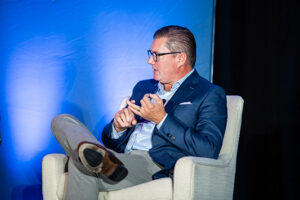
Jeff Shaner
It’s still about people
After considering such factors as geography, “then you really get into the quality of the company, and technology is very important,” Shaner said. “But I would start with the leadership team. At the end of the day, you’re really betting on human beings and leaders, and you’re looking for a couple of things. You’re looking for how was their culture?”
Specifically, Shaner examines whether a company’s culture was created especially to look attractive to potential investors, “or does their culture run a decade, two decades, three decades deep? What is their commitment to clinical excellence and compliance? In our business, that is the fabric for how we operate.”
“When we evaluate companies, we’re really looking at the quality of the people, the quality of the business,” Shaner said. “You do want to know that they’re on a standardized operating system, one payroll system, and that they have a technology stack. From our point of view, it doesn’t need to be the most sophisticated technologies — but just that they commit to an operating model, and that they do it very well.
“But I think if I go back — the best companies we’ve ever acquired have been companies that have great leadership teams and have a really good basis and ethos around clinical compliance and doing things the right way. The other stuff I think we can improve as we acquire.”

Bill Mixon
Mixon agreed that the team at the center of the possible investment is key.
“At Waud and other private equity firms I’ve been associated with, the quality of the team, and/or a strategy,” he said in describing priorities. “Is there a need to make some adjustments to the team? is really the number one on the list. All of the other things that Jeff said, you know, also do happen. But if you go into a management presentation and the team is just not cohesive, and there’s a sense about the culture, etc., it’s hard to get to the to the rest of the conversation. You immediately have to start talking about well, what are we going to do to make sure that we have the right leadership team in this business? So I would put leadership team, etc., as number one on that list.”
“I would echo that,” Distefano said. “It’s easy for me to go into a home care agency and say, ‘Here’s your revenue. Your gross margin is 50% or higher, that’s good. Your bottom line is 50% or higher, that’s good. What’s in the middle? There’s not a lot left in there, right? So I put that aside, and I look at the key players.”
Editor’s note: This is continuing coverage of FUTURE 2026. Stay tuned for additional stories on other FUTURE panels, including perspectives from the C suite, and Medicare Advantage strategies.
Images: Merz Photography