
Dustin Distefano (from left), Bill Mixon and Jeff Shaner at the M&A panel in Austin.
From a home medical equipment insider’s perspective, 2026 has been a year largely driven by the Centers for Medicare & Medicaid Services’ (CMS) ongoing priority of curbing fraud, waste and abuse. That focus led to February’s six-month moratorium on enrolling new durable medical equipment (DME) suppliers, as well as CMS’s rollout to restart Medicare competitive bidding for certain DME categories.
While DME suppliers have had their hands full with policy issues, have these uncertainties and changes impacted the appeal of home-based healthcare to potential investors? After all, while the six-month DME supplier moratorium expired on Aug. 27, the hospice and home health segments remain under new provider enrollment moratoria that began in May.
That was one of main topics discussed in Capital, Consolidation and Comebacks: State of M&A for At-Home Care and HME, a panel presented at the Home Health Care News/HME Business FUTURE conference in Austin, Texas, in late August.
What’s the M&A landscape like now?
Industry veterans Jeff Shaner, Dustin Distefano and Bill Mixon headlined the panel that closed out the first day of education and networking at FUTURE, designed specifically for DME, home health and hospice leaders.
As chief operating officer of franchise operations at A Place at Home, Dustin Distefano focuses on supporting the organization’s franchise network and growth strategy. He was asked what the current M&A landscape was like a few years ago compared to now.
From a home care perspective, Distefano said, “I think it was the wild west. I remember as a franchisor, my PE [private equity] phone calls skyrocketed probably about three years ago. I was a small franchisor, so they would call me and they’d say, ‘Dustin, are you interested in buying this? Look at it.’ I’d say, ‘Here’s my EBITDA,’ and then say, ‘Hey, never mind.’ We just did that dance for a while.”
But as A Place at Home scaled, “those calls kept coming and coming,” Distefano added. In February, A Place at Home was acquired by Dovida, a global provider of home care services in Australia, France, Ireland, the Netherlands, New Zealand and Switzerland. The deal marked Dovida’s entry into the United States.
“I think that the sophistication of buying is different today than it was 24 months ago,” Distefano added. “Our CEO told me, ‘We can sit and buy all this EBITDA and it could be flat EBITDA — just buy a bunch of it that really looks good on paper. But what we’re looking for now is where’s the growth? Who’s showing organic growth? And we were showing that, and that really excited me. And that’s one thing that I really work with my owners on now: saying, hey, you’ve got to show positive organic growth.”
An always-evolving landscape
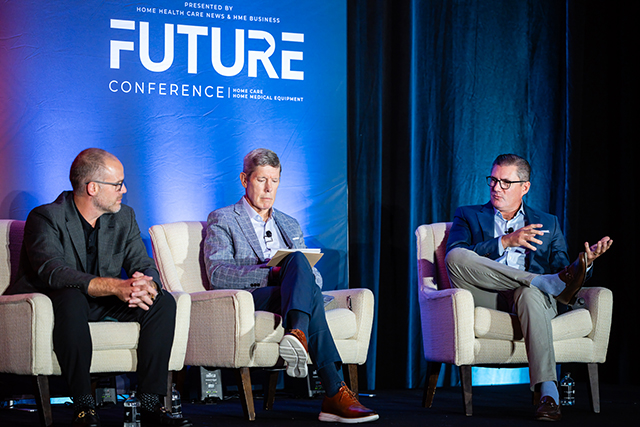
“The best word I could use is evolving,” said Jeff Shaner, Aveanna Healthcare (far right).
Regarding changes to the home care M&A outlook in the last few years, “I think the best word I could use is evolving,” said Jeff Shaner, CEO of Aveanna Healthcare, a provider of home health and related home-based care services.
“It’s been an evolving market, sometimes better depending on which healthcare business you’re in, and sometimes worse over the last 24 months,” Shaner added. “In my mind, it’s really driven by a couple of structural things. We’ve heard a lot today about regulatory changes. And out of regulatory changes comes reimbursement, either certainty or uncertainty.”
He referred to H.R. 1, known as the One Big Beautiful Bill, “which had a massive impact to Medicaid providers across America. So if you’re on the Medicaid side of things, in the last few years you probably weren’t saying that the M&A landscape has been overly positive from multiples or an amount of transactions of size.
“The flip side I think we see is with reimbursement certainty, like hospice: You do see a meaningful, continued uplift in M&A transactions and multiples.”
Your M&A perspective therefore, Shaner said, depends “on which part of the landscape you’ve been on, in some cases. Some of us are in all parts of the landscape.”
The DME perspective
Bill Mixon is an executive partner at Waud Capital, thus bringing an investor perspective to building and supporting health care businesses. Mixon has logged years of experience in the Complex Rehab Technology and DME segments, having been the longtime CEO of National Seating & Mobility, and then the CEO of Advanced Diabetes Supply Group (ADSG) when ADSG was acquired by Cardinal Health. That deal was completed in spring 2025.
“I come at that question with quite a broader perspective because I’m an HME, DME and home health person,” Mixon said. “That’s what Waud does. Investors need to have a strategy. They need to have a thesis about what they’re trying to accomplish with the money that they’re trying to invest.”
Mixon noted the basic structural, foundational aspects of home-based care and said, “Those macros are really good. We’re all getting older. I think that one of the things that private equity in particular likes to hear is that they have a valid thesis around a potential investment. And anything that revolves around home is going to be attractive to the folks in private equity.”
Editor’s note: This is continuing coverage of FUTURE 2026. Next up: the value of DME and home-based care to investors, and what factors create an attractive investment.
Images: Merz Photography