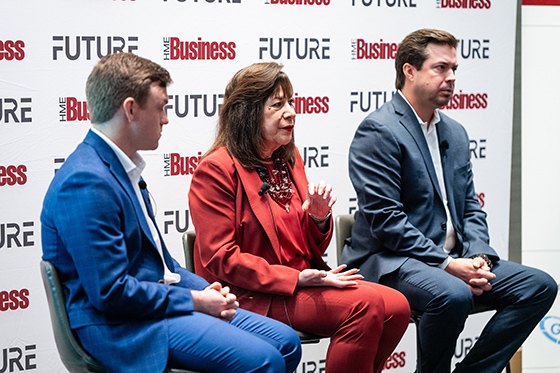
Zach Mastrovich (left), Gayle Devin and Russell Woods discussed resupply experiences — and what the future of resupply could be like —at the HME Business FUTURE conference in Dallas.
On a sweltering Texas afternoon in September, a panel at the HME Business FUTURE conference — hosted at the JW Marriott Dallas Arts District —was tackling the topic of resupply.
At that time, the final home health rule from the Centers for Medicare & Medicaid Services (CMS) was still more than two months away. But the panelists — Gayle Devin, CEO, Home Care Delivered; Zach Mastrovich, vice president of process improvement & resupply, Performance Home Medical; and Russell Woods, vice president of account management, Parachute Health — were already looking toward a future where resupply would play an expanded role.
Describing successful resupply programs
“I started off my career working in auto insurance as an actuarial analyst, Mastrovich told audience members. “So I was really, really excited to bring an analytical angle to what we do for our resupply program at Performance Home Medical.” The Kent, Wash.-based provider focuses mainly on the sleep space, “so we do a lot of CPAPs, vents, O2, in the Pacific Northwest,” Mastrovich added.
Asked how he defines a good resupply program, he said, “At the end of the day, providing that good patient experience is the core foundation of not only our mission statement, which is patient first, but also how we run our resupply department. Our belief is that if you take care of your patients — if you’re timely with them, if you communicate well with them, if you provide them the supplies that they need on time, every time — everything else will take care of itself.”
Successful resupply programs can vary significantly, Mastrovich added.
“There’s a whole bunch of KPIs [key performance indicators] that I’d love to talk your ear off about; I think there are 1,000 different ones that are all relevant. But at the end of the day, a good resupply program takes that patient-first approach. Are we communicating with our patients? Are we accessing them where they want to be accessed: email, text, phone calls? If patients want their supplies every three months, are we offering them that option so they don’t have to think about it and it just shows up to their door? So it’s really what do we do from a customer service level, from a patient-care level, that helps us elevate our patients, helps bring value to their lives?
“That’s our driving force. Take care of your patients. Everything else takes care of itself.”
Reducing pain points
Russell Woods is now a vice president at Princeton, N.J.-based Parachute Health, which works to simplify, accelerate and improve durable medical equipment (DME) ordering for home medical equipment HME) providers — and therefore, to also improve outcomes for clinicians, payers and ultimately, patients.
But before Parachute Health, Woods clocked 15 years of provider experience, knowledge he’s applied to building strong resupply processes for current suppliers.
“It was pretty manual back then,” Woods said of back office work. “But now it’s starting to close up some of the gaps that we’ve seen on the HME provider side of the business when it comes to making sure supplies are sent to patients as effectively and efficiently as possible. Like Zach said, if patient care is the North Star, and you’re setting them up for success and getting those prescriptions filled as pain free as possible, and if the patient is not aware of what happens in the background because the supplies just show up — that means there’s a process in place. That physician can get that prescription signed and renewed, the order can be given to the HME provider to then dispense the product and then successfully bill for it.
“That’s what you want, without any problems, any delays, so that prescription can be adhered to, and nobody’s wearing dirty CPAP masks, nobody’s using dirty nebulizer kits or a dirty trach.”
One size doesn’t fit all
Gayle Devin, the CEO of Home Care Delivered in Glen Allen, Va., joked that she’s been in the industry “since dinosaurs roamed the earth” and has therefore seen “the good, the bad and the ugly, working as CEO of respiratory companies and more recently, diabetic and medical supply companies, particularly PE [private-equity]-backed companies.”
While she agreed with Mastrovich’s and Woods’s comments, Devin added a caveat: For resupply, one size does not fit all.
“When resupply first became in vogue, it was CPAP resupply, with nebulizers,” Devin said. “But now it’s expanded beyond that to recurring medical supplies. Speaking of our experience at Home Care Delivered: We provide incontinence supplies, we provide urologicals, we provide ostomy supplies and wound care. And if I look at success, yes, it’s patient satisfaction. We’re a patient centric organization.”
Beyond making efficient deliveries a priority, though, Devin added that successful resupply programs track patients and their journeys.
“It’s making sure that if a patient’s needs change as their disease progresses, that you’re making sure they’re in the right product,” she said “Specifically about incontinence: Getting the size and fit for an incontinence product is essential to meeting the patient’s needs.
“Someone may come on service at a certain weight, and their incontinence may be mild. But three months down the road, they’ve lost a lot of weight. The size is not going to fit. They’re going to have leakage.”
By that time, however, the patient might not remember who the provider is, and therefore might be unable to reach out from their end. And that scenario harms both the patient who is no longer using an appropriate product, and potentially the provider, if the patient loses interest in reordering.
Know your resupply patient
Ultimately, Devin said, the success of a resupply program is “really based on what is your break-even point? I know it’s going to vary, depending on what your cost of goods is, what your cost of service is inclusive of freight and shipping.”
But when does a resupply patient become profitable? How many months of service does a supplier need to provide?
“There are benchmarks for different product categories,” Devin said. “For an adult incontinence patient, five years is kind of the benchmark. Depending on your cost structure, it could be that you break even at month four or month three. But if you lose that patient, then obviously you lose that revenue stream.”
To retain resupply patients, “Every third month, depending on the product category, we would call the patient,” Devin said. “We really saw a dramatic improvement in customer retention.”
Those calls give patients and suppliers the chance to catch up — which includes checking on how well those resupplied products are working. “When you lose weight, you lose weight in your face,” Devin said. “With CPAP masks, if that seal isn’t tight, there’s going to be leakage. There’s going to be a problem.”
Checking in personally with patients — even ones who appear to be happy reordering via automated systems — can strengthen patient-provider relationships.
“I think you really want to meet the patient where they are, or the caregiver where they are,” Devin said. “Text reorder may be great, IVR [interactive voice response] may be great. But there are times when that phone call to ensure that they’re in the right product as their disease progresses or as they’re at a different point in their continuum of care can ensure that patient stays sticky.”
Open channels of communication
Mastrovich said his team keeps close tabs on “our demographics and how [patients] respond to each channel of communication that we have with them. How do they respond to a given text or an email versus if we call them? It’s tracking those sorts of metrics that — to expand what Gail said — meet the patient where they are.
“Some patients just want to order off their phone. Some patients need that extra push from someone calling them and asking them, ‘Hey, are your supplies still fitting? Are you noticing any leaks? Are you getting indents in your in your cheeks because you’re pulling your mask on too tight?’ It’s tailoring your approach to each patient, while still having a robust back end to be able to handle and process all the orders you’re getting to ensure quality patient care.”
Devin added that keeping in touch with patients also presents the opportunity to loop in other members of the health care team.
“Sometimes people don’t realize the value that we serve as suppliers,” she said. “We’re in touch with the patient more frequently than their doctor [is]. And we notice that a size has changed, we notice that they’ve lost or gained weight.”
And that observation can lead to reaching out to case managers or doctors, “because [the patient] may need to be seen. From the doctor’s standpoint, they view that as ‘This is a company I want to do business with, because they are not just shipping blindly. They really know what’s going on with the patient.’ It’s really led to more business from different referral sources for us, and from the payers’ standpoint as well.”
Building resilient resupply programs
There are many benefits to resupply. There are also many challenges, particularly as providers constantly look for ways to cut costs.
“I think over the years, you’ve seen a decline in hands-on service as the reimbursement rates have dropped, and competitive bidding has become a thing and soon will be again,” Woods said. “Fifteen to 20 years ago, there was an RT [respiratory therapist] in every home taking care of every oxygen patient, every CPAP patient. And then it was well, it doesn’t have to be an RT; it could be an LPN [licensed practical nurse]. And then: Well, it can be an unlicensed service tech. And then: We can just drop ship it; we’ll put a DVD in there. Now it’s a QR code.”
That migration away from providing expert education to patients, Woods added, isn’t necessarily what suppliers want. “I think it’s survival.”
Given the need to be cost effective, how can providers maintain great relationships with resupply patients, as well as with their referral sources?
“Ultimately, with the patient and any patient-facing interactions — I don’t think we can make changes there,” Devin said. “If you’re going to look at revenue flow, it’s retaining those patients. As we look at what we’re potentially faced with in competitive bidding, what other efficiencies on the back end are non-customer facing? From the revenue cycle standpoint, I think there could be opportunities there.
“How are you handling shipping? Have you looked at what you can do less expensively, if you use a 3PL [third-party logistics] versus handling it yourself, based on where you’re located and where [shipments] are going? I know the stance we’re taking is with any patient-facing activity, we can’t compromise.”
Saying that it would be “pretty hard not to” be thinking of competitive bidding’s impact on HME provision, Mastrovich said, “We’re always looking for ways of making our process better. That’s just core to what our business is about. How do we streamline?”
Competitive bidding, he added, is “only going to make our timeline quicker on that.” But Mastrovich said, in agreeing with Devin, “If we were to touch something on the patient interaction front, it would be [to make] an improvement. You cannot cut corners there. That is the whole crux of what makes this work. It’s our role as a provider to help out and be that extra leg of patient education to their doctor. You cannot sacrifice that.”
Therefore, cost savings must be accomplished another way: “It all has to be back office efficiency,” Mastrovich said.
Good business up front
Woods said, “I think the smart thing that we see happening is getting good business up front. When I say ‘good business,’ that means good orders without back and forth — billable qualifying orders for all product lines. There’s no held revenue. There’s not as many write-offs, bad debt, things like that.
“And when those patients are due for the renewal piece, whether it be just a renewed prescription for oxygen or a new prescription to receive the next 90 days’ shipment of supplies, make sure that’s a very buttoned-up process.
There are ways we can automate pulling that data out, sending it out, and plugging it back in. And I think what a lot of HME providers have seen so far in that process is it frees up their sales team to have real conversations in the field about patients they can help that day, new therapies on the market, new pharmaceuticals, etc. They’re not out there just chasing a bunch of papers that require addendums and new prescriptions that need to be fixed. And so that rep is out there actually selling to grow the business.”
As for what challenges they anticipate in the coming year, Mastrovich said, “AI [artificial intelligence] is really going to completely change the landscape. I called to order pizza the other night, and it took me two or three minutes [to realize] I was ordering through AI. I thought I was talking to a real person, I had no idea.
“Am I OK with this? I think so, it’s working. Where does that go from here? Can we start doing AI outbound calls? Will patients like that? Are we there yet? What does that landscape look like? Will patients prefer it? Maybe.”
Devin mentioned the challenges of rapidly changing technology, such as an Apple update that changed how spam texts and calls are handled by iPhones. She noted such changes could be a big problem “because a lot of our demographic just doesn’t add our phone number [to their phones].” Home Care Delivered’s team has made an “all-out attempt to make sure” their customers have added the company’s phone number to their contact lists.
And as the industry begins to tread new policy ground, Woods noted the importance of “the ability to kind of bob and weave going forward with any changes that are coming down the pipeline in the next 12 months. Anytime there’s a sudden change in guidelines from CMS, we have to kind of put our ear to the ground and see what our customers want us to do. I think we’re poised to respond pretty well to any surprises.”