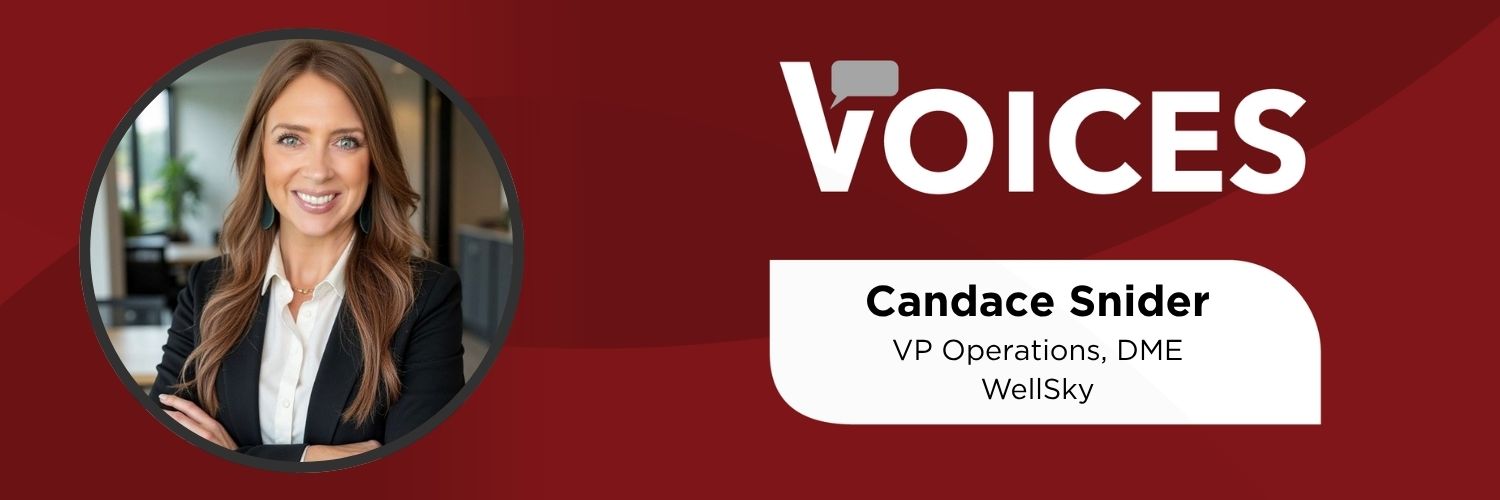
This article is sponsored by WellSky. In the DME space, technology only matters if it helps providers operate better, scale smarter, and adapt to a market with growing complexities. WellSky is building toward that standard by bringing proven resupply and patient engagement tools into a broader post-acute ecosystem designed to support providers across the full care journey. In this Voices interview, Candace Snider, vice president of operations, DME, at WellSky, shares what providers should expect from modern DME technology, reflects on how her experience shaped that perspective, and explains what will distinguish the platforms that drive growth in 2026.
HME Business: What core experience has most shaped the way you think about the DME space and the role technology should play in it?
Candace Snider: My perspective is shaped by having been a DME provider myself. I’ve led large, complex DME organizations, and I understand what it feels like to be accountable to boards, private equity, referral sources, and, most importantly, patients.
I don’t answer this from a software lens alone. I answer it from my experience in being responsible for operations and outcomes. DME providers deal with complexity every day – payer requirements, documentation, authorizations, revenue, resupply, inventory, patient outreach, reimbursement, staffing and more. They must balance all of these competing priorities without compromising compliance, service, or quality. That’s not easy.
Those experiences shaped my belief that technology must do more than digitize tasks – it must make the business easier to operate. It must help teams see risk earlier, reduce manual work, improve consistency, support growth, and give leaders better visibility into what is actually happening across the organization. The technology also must contribute to a successful long-term strategy, because while meeting today’s needs is important, providers also need to be well-positioned for the future.
For a long time, I think the DME space has been underserved from a technology standpoint compared to other parts of healthcare. Providers have been expected to run highly complex businesses with fragmented systems, limited connectivity, and piecemeal functionality. That’s why modern DME technology must be operationally deep, scalable, and built for long-term connectivity across the broader health care ecosystem.
Tell us about the journeys Bonafide and S3 Resupply took to acquisition, and how becoming part of WellSky has shaped what the platforms are today.
Bonafide and S3 Resupply both had long histories in the DME space well before becoming part of WellSky. Bonafide was built around the operational complexity DME providers deal with every day. It’s an enterprise resource planning (ERP) platform that supports core workflows like intake, order processing, billing, inventory, documentation, and fulfillment. S3 built its strength around resupply and patient engagement – originally in CPAP resupply and now expanded to other resupply lines – where consistent outreach, workflow management, and strong service execution are critical.
Both businesses were already focused on helping DME providers operate more efficiently, and both had developed into strong, best-in-class platforms in their respective areas. That’s really what made them such a strong fit for WellSky. The late October 2024 acquisition introduced a first-of-its-kind offering for the DME space: a truly comprehensive, long-term strategic solution for providers.
Becoming part of WellSky added a broader strategic layer to both platforms. It brought Bonafide and S3 into an organization with strong health care technology infrastructure, deeper investment capacity, and much broader connectivity across acute and post-acute care settings. That matters because DME doesn’t operate in a vacuum. Providers are connected to payers, referral sources, clinicians, home health, hospice, and many other stakeholders across the care continuum.
Being part of WellSky gives us the opportunity to think beyond individual workflows and look more strategically at how DME can become more connected, more visible, and better positioned within the broader health care journey. This strategic vision is what really shapes what the platforms are today.
What is driving WellSky’s strategy in the DME space today?
WellSky’s DME strategy is driven by the belief that DME providers need technology that is both operationally practical and strategically connected. Faced with rising complexity and the pressure to do more with less, providers need far more than a basic system of record or a claims-processing tool. The DME space has evolved well beyond that.
Our focus is on helping providers strengthen their operations while positioning them for where the market is headed. That means more efficient workflows, better visibility, responsible AI, impactful patient engagement, and broader connectivity across the care ecosystem.
The strategy isn’t just about supporting DME as a standalone vertical – it’s about recognizing the role DME plays in the larger healthcare journey. DME providers have a real impact on patient outcomes, therapy adherence, avoidable utilization, and the total cost of care. Technology should make that role easier to execute and easier to demonstrate.
What makes Bonafide and S3 Resupply stand out in the DME technology landscape?
Bonafide and S3 Resupply stand out because they combine deep DME expertise, operational maturity, and real service knowledge. Bonafide was built for the day-to-day realities of DME operations. It supports the complex workflows providers depend on every day, from intake and documentation to billing, inventory, fulfillment and revenue cycle. DME may look simple from the outside, but the reality is far more complex. The platforms serving this market must be able to handle that complexity at scale and with real strategic intent.
S3 stands out for a different reason. Resupply is not only a technology workflow, but also a service model. Success depends on consistent outreach, strong patient engagement, payer and documentation awareness, operational discipline, and the ability to keep programs performing over time. S3 has developed that expertise over many years, and it’s widely recognized in the market for both service quality and results.
Together, Bonafide and S3 give providers a strong operational foundation across two critical parts of the business. Now, as part of WellSky, that foundation is supported by broader technology investment, stronger infrastructure, and greater connectivity across the larger care continuum.
How does WellSky’s broader post-acute care network create value specifically for DME and HME providers?
The value really comes down to connectivity and perspective. DME providers are an important part of the post-acute care journey, but historically, they have often been treated as if they sit outside of it. This has limited the industry’s ability to show the full value it creates.
WellSky has a broad presence across post-acute care settings, and that creates an opportunity to think differently about how DME fits into the larger ecosystem. DME providers interact with patients in the home, support adherence, mobility and respiratory care, and help manage chronic conditions in ways that directly affect outcomes and cost. DMEs play a much larger role than they are often given credit for.
For DME providers, the long-term opportunity is developing a stronger connection to the broader healthcare journey, not just through basic data exchange, but through smarter workflows, better visibility, stronger insights and tighter alignment with the other care delivery stakeholders. Providers don’t just need software to run transactions – they need technology that helps them become strategic partners across the continuum.
How has your experience as a former DME provider shaped your view of what technology should actually deliver for providers?
My experience as a former DME provider has made me more practical than anything else. Providers don’t need technology that sounds great in a demo but falls apart when the workflow gets difficult, or a more complex scenario comes through. They need tools that help them move faster, reduce administrative work, manage exceptions, and understand where the business is getting stuck.
It is great to see what is working well, but it’s even more important to know where the roadblocks are and how to improve them. When I was on the provider side, we were always looking for more efficient ways to connect with payers, referral sources, and other healthcare stakeholders. We wanted better data, more visibility, and better ways to demonstrate the value DME brings to patient care. At the time, the technology and connectivity in the market were still relatively immature, and that’s part of what led me to Bonafide and S3.
I’ve used both Bonafide and S3 across multiple companies, and both delivered real value in operating the business and supporting patient care. That experience still shapes how I evaluate technology today. Does it help providers collect faster? Does it reduce missed opportunities? Does it make documentation and payer compliance easier to manage? Does it improve patient engagement? Does it help leadership see problems before they get bigger?
At the end of the day, if technology doesn’t improve the operation, then it’s just not enough.
Looking ahead, what will separate DME technology platforms that truly help providers adapt and grow in 2026 from those that fail to keep pace with the market?
From my perspective, what separates the platforms that will matter is whether they can keep pace with how the market itself is changing. Costs are rising, reimbursement is tightening, and pressure on providers continues to build – none of which is news to the industry. What is changing is how stakeholders are aligning around the provider.
The old model of a more direct relationship between provider and payer is evolving. More organizations now sit in the middle of providers and payers, and in some cases between providers and patients. That changes referral patterns, service workflows, and the way DME providers have to operate. The platforms that succeed will be the ones that can help providers navigate both the complexity and the broader market shift happening around them.
DME providers are facing more pressure than ever before. Payer rules are more complex, staffing remains a challenge, margins are tight, patients expect better communication, and leaders need better data and broader visibility across the healthcare ecosystem. A modern platform that handles basic claims and inventory isn’t enough anymore. Providers need technology that gives them a real strategic advantage.
The winners will be platforms that combine operational depth, automation, AI, analytics, patient engagement, interoperability, and scale with providers’ growing needs. Those are the capabilities that will help providers run a better business today while preparing for a more connected and demanding future.
Editor’s note: This interview has been edited for length and clarity.
Learn more about how Bonafide and S3 Resupply, powered by WellSky, support DME providers across the nation.
https://wellsky.com/dme-hme-software/
The Voices Series is a sponsored content program featuring leading executives discussing trends, topics and more shaping their industry in a question-and-answer format. For more information on Voices, please contact [email protected].