Home medical equipment (HME) companies and other healthcare providers are becoming more selective when picking their top technology partners.
That’s according to WTWH Media’s M2 Research project, which surveyed healthcare professionals across several industries about how they discover, evaluate and choose vendors.
For HME organizations, the findings reveal there’s a wide gap between content that helps inform a purchasing decision and content that adds to the noise. For the most part, survey respondents said they place the most value on practical materials such as best-practice guides, case studies, research reports and demonstrations, while generic outreach and less tailored messaging carry less weight.
WTWH Media is the parent company of HME Business. Other WTWH Media healthcare brands include Home Health Care News, Senior Housing News, Hospice News, Skilled Nursing News, Behavioral Health Business, Ambulatory Surgery Center News and Mobility Management, all of which contributed audience insights to the M2 Research project.
Overall, the research is based on 905 complete responses and 252 partial responses from late October 2025 into early December 2025. Respondents included a mix of decisionmakers and influencers: 21% identified as VP or director level, 18% as C-suite, 17% as administrator or executive director, and another 17% as manager or supervisor.
One key takeaway from the M2 data is that buyers value content that is directly tied to solving operational or strategic problems. When asked which types of content are most valuable in their professional roles, 64% of respondents selected best-practice guides or how-to playbooks. Another 53% selected case studies with measurable outcomes, while 51% pointed to research reports with data and benchmarks.
For HME buyers, that suggests practical information still matters more than volume or “sizzle.” Materials that help explain how a solution works in a real setting – and what results it produced – appear to resonate more than broad promotional messaging.
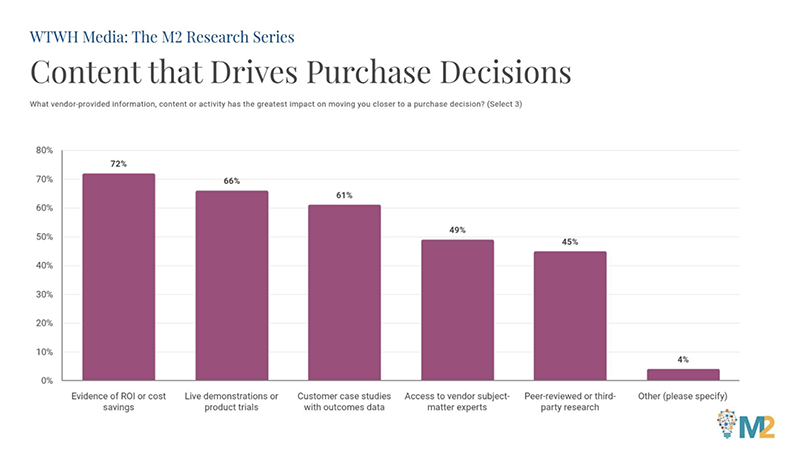
The survey also looked specifically at which vendor-created formats have the greatest impact on decision-making. Again, respondents favored proof-oriented materials. In fact, 64% selected case studies from similar organizations, 56% selected on-demand product demos or videos, 53% chose ROI calculators and benchmarking tools, and 52% pointed to webinars with practitioner participation.
Those findings suggest buyers are looking for information that is both relevant and usable.
How buyers decide whether content is worth engaging with in the first place is another notable takeaway.
Asked how they assess content value prior to clicking, 57% cited the reputation of the source, while 54% pointed to a concise summary or bullet points previewing the insights. Another 42% said up-to-date research or data mattered, and 41% cited a clear title and subtitle.